
VizAi Tech
Built for the fleet bay

Fleet Maintenance Documentation Without the Paper Trail

ServiceOS ties technicians, work orders, inspection results, and media into one unit history for every truck and trailer. Pre-trip findings, PM intervals, and repair evidence land in the same record automatically, so maintenance managers can prove compliance and spot repeat failures without digging through binders.

The hardware

On the driver. On the tech. On the inspector.

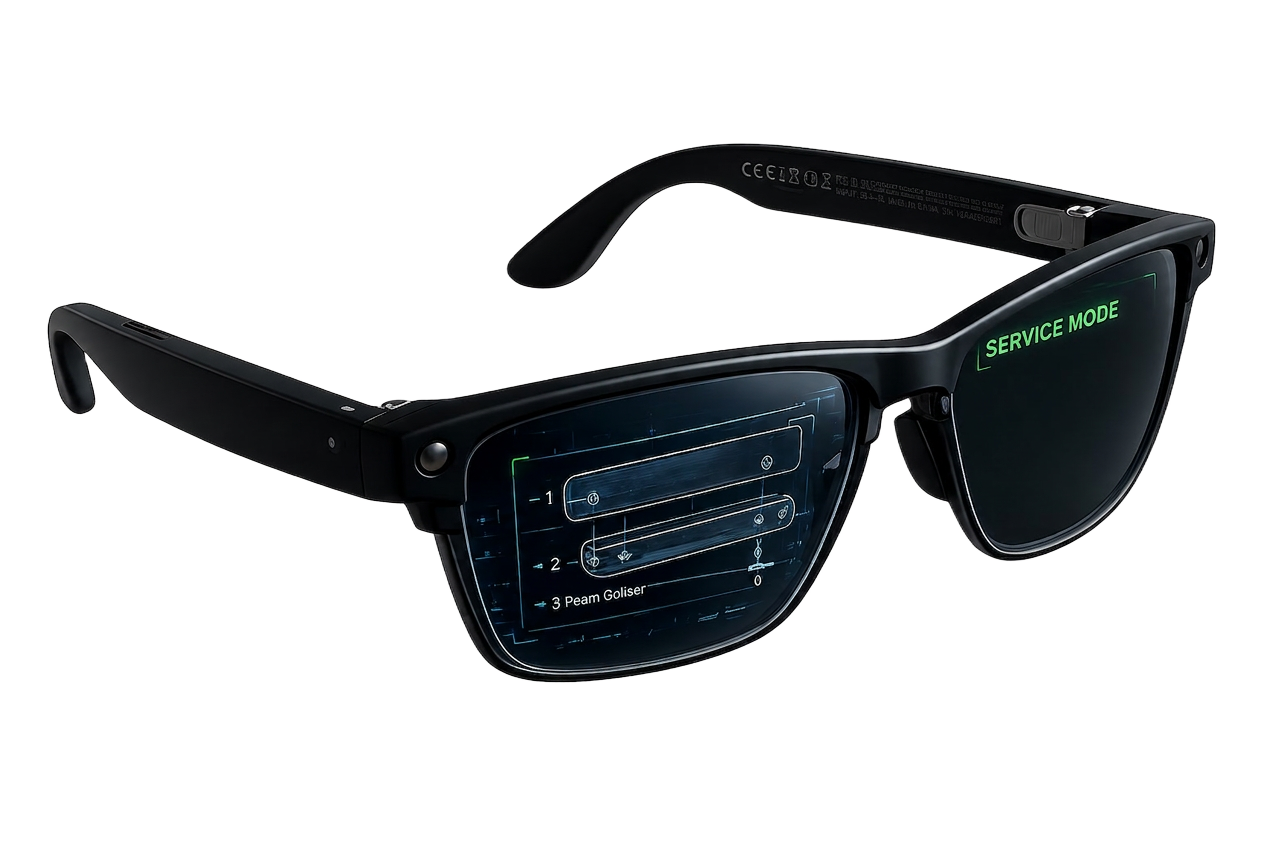
Lightweight AR glasses keep the tech's hands on the truck while the heads-up display surfaces the inspection checklist, torque specs, and prior fault history — all driven by what they're looking at.

VizAi AR smart glasses for fleet inspections
What the tech sees

POV — Live tractor-truck inspection

Engine start, belt routing, tire tread depth — checked off live, hands-free, in real time.

REC · POV-01
UNIT 4471|DOT PM-A
DETROIT DD15
IDLE 612 RPM
Coolant · 184°F
BELT GLAZING · ALT
Task · PM Inspection
Start diesel engine
Check belts
Check tread
BATT 84%
09:14:22
BAY 07 · SHOP
Use cases

Every Truck. Every Trailer. Every PM Interval.

From pre-trip walkarounds to annual DOT — capture once, share everywhere.

Engine starts

Cold-start audio, idle RPM, and dash codes captured on the first crank.

Belt & hose checks

Routing, glazing, and cracking flagged from POV video.

Tire tread & pressure

Voice-tag each position with depth and PSI as you walk the rig.

DOT violations

Flag a defect, narrate context, generate the out-of-service report.

PM photo packs

Walk the unit, capture every checkpoint hands-free, sign on the spot.

Driver vehicle reports

Time-stamped photo + video evidence attached to every DVIR.

Platform

ServiceOS, Tuned For Fleet

The same VizAi platform that runs marine, aviation, and auto service — reframed for fleet managers, lead techs, and DOT inspectors.

Truck & trailer records

Organize by VIN, unit number, domicile, and PM schedule.

Crew roles

Fleet manager, lead tech, driver, and DOT inspector — each with the right access.

Live POV streaming

Loop in the shop foreman or warranty rep from anywhere.

Auto-tagged tasks

Voice and gesture tag work as complete, deferred, or out-of-service.

DOT & FMCSA ready

Audit-ready documentation packages exported in one click.

Fleet-ready reports

DVIRs, PM logs, and warranty packets — generated for you.

Fleet and commercial maintenance

Service Work Happens Everywhere. The Record Shouldn't.

Fleet maintenance is distributed by definition. Vehicles are spread across yards, terminals, and job sites, and the techs servicing them work wherever the truck happens to be. The record of that work should not depend on which phone was in whose pocket.

Inspections generate the most documentation and receive the least structure. Defects get noted on paper, photos get taken and buried in a camera roll, and the maintenance history for a specific unit ends up assembled from memory when a question comes up months later.

The result is a fleet where the work is getting done well but is nearly impossible to reconstruct — vehicle by vehicle, tech by tech, date by date.

  • Vehicles distributed across yards and terminals
  • Inspection documentation on paper
  • Maintenance histories that are hard to reconstruct
  • Technicians working in yards, roadside, and shops
  • Photos buried in personal phones
  • Keeping accurate vehicle-specific repair records
How ServiceOS helps

One record for the work, built while the work gets done.

Document Work as It Happens

Capture service photos, video, notes, and work documentation while technicians perform the job — not hours later from memory.

Organize Everything Around the Work

Every file stays connected to the right repair order, job, asset, and work step, so nothing has to be sorted by hand.

Create a Permanent Service Record

Build an organized history of work instead of leaving evidence scattered across phones, messages, folders, and paper.

Give Managers Visibility

Service managers review work documentation and supporting media without constantly interrupting technicians.

Capture Hands-Free

Where supported, wearable technology lets technicians document work without reaching for a phone mid-job.

Turn Service Activity Into Useful Information

AI-assisted workflows help organize and summarize service documentation so the record is easy to review and share.

Fleet and commercial maintenance

The paper problem in fleet maintenance

Fleet shops generate an enormous amount of documentation and keep almost none of it usefully. DVIRs get filled out, filed, and never read again. PM sheets sit in a folder by unit number. Repair photos, when they exist at all, live on whichever technician's phone happened to be closest to the failure.

That matters when a roadside inspection, an accident review, or a warranty claim forces you to reconstruct what was actually done to a unit and when. It matters even more day to day: without a searchable history, a shop cannot see that the same wheel seal has been replaced three times on the same trailer, or that one vendor's brake job keeps coming back.

Paper also slows the bay. A technician who has to stop, wipe their hands, and write on a clipboard documents less than one who can capture as they go — and the documentation they do produce is the thinnest version that satisfies the form.

How ServiceOS runs a maintenance bay

Every unit in the fleet has a permanent record keyed to VIN or unit number. Work orders open against that record, and each inspection or PM service loads its own guided checklist — DOT annual, A/B/C PM interval, brake job, tire program, whatever your shop runs.

Technicians work the checklist and capture as they go. Tread depth reading, air leak at the gladhand, cracked bushing, corroded connector: each capture attaches to the step that produced it, with the technician, timestamp, and unit already applied. Voice notes cover what a photo cannot.

Faults flagged during inspection convert into follow-up line items instead of disappearing into a comment field. The shop foreman sees them on the board immediately, with the evidence attached, and can prioritize the ones that will take a truck out of service.

  • Unit records by VIN or fleet number with full repair history
  • Guided DOT, PM, and repair checklists tuned to your program
  • Findings that convert directly into scheduled follow-up work
  • Offline capture for yards, roadside calls, and remote terminals

Compliance you can produce on demand

Compliance documentation is only valuable if you can retrieve it. ServiceOS keeps inspection results, technician sign-offs, and supporting media in one place, searchable by unit, date, technician, or defect type. Producing a complete maintenance file for a specific tractor is a search, not an afternoon.

Because every capture carries its own timestamp and author, the record stands up to scrutiny. There is no gap between when the work happened and when it was written down, which is exactly the gap auditors and plaintiff attorneys look for.

What maintenance managers actually get out of it

The operational payoff is visibility. A live board shows every unit in the shop, what stage it is in, which tech owns it, and what is blocking it. Downtime becomes measurable rather than anecdotal, and the shop can tell operations when a truck will actually be back.

Over time the record becomes analysis. Repeat failures by component, by make, by vendor, and by terminal become visible without anyone building a spreadsheet. That is where fleets find real money: a warranty claim they were entitled to and never filed, a spec change that eliminates a recurring failure, or a vendor whose comeback rate justifies a conversation.

For outsourced work, the same record holds vendor accountable. Photos in, photos out, and a clear timeline of what was promised and delivered.

  • Live shop board with downtime and stage tracking by unit
  • Repeat-failure visibility by component, make, and location
  • Documented evidence for warranty recovery and vendor disputes

Built for how techs actually work

Fleet technicians are not going to adopt a system that adds steps. ServiceOS is built so documentation takes less time than the clipboard it replaces: capture happens on the device already in hand, or hands-free through AR glasses when a tech is under a truck with a light in one hand and a wrench in the other.

Nothing has to be transcribed at the end of the shift. When the tech closes the work order, the documentation is already complete, already attached, and already visible to the foreman.

Common questions

Does ServiceOS replace our fleet maintenance software?
It complements it. ServiceOS handles the documentation layer — checklists, media, technician evidence — and exports completed records into the system you already use for scheduling and parts.
Can drivers submit pre-trip findings into the same record?
Yes. Driver-reported defects can open against the unit record so the shop sees the report and the supporting photo in one place.
What about multiple terminals?
Records roll up across locations. A maintenance director can compare throughput, downtime, and comeback rates by shop.
Is capture usable in a yard with no signal?
Yes. Everything captures offline and syncs when the device reconnects.

Retire the binder. Keep the record.

See how fleet maintenance teams use ServiceOS to document inspections, prove compliance, and cut downtime.